Research Labs
What Does 'Hyper-Personalized Advertising' Actually Mean for a 500-Location Brand?
Why personalization at scale is really a data and trust problem
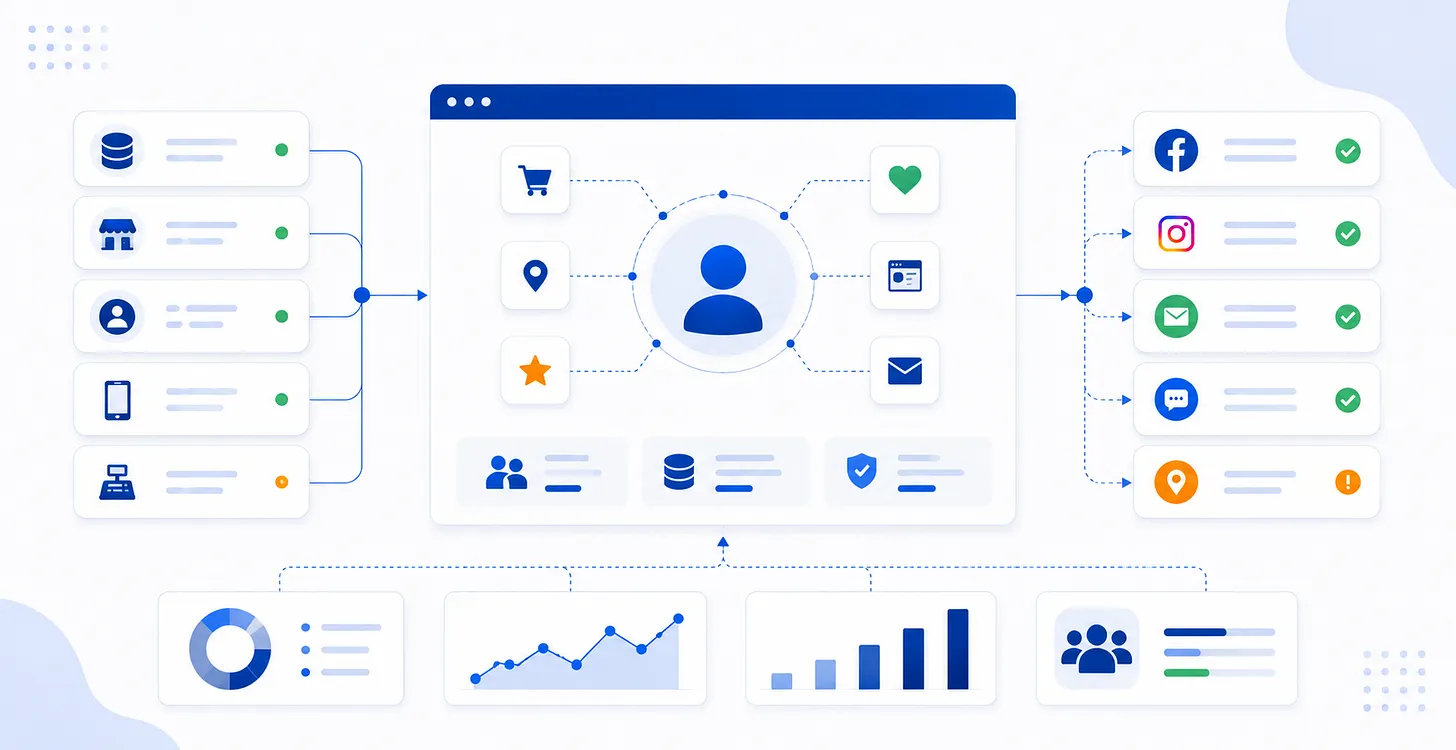
Every conference talk on personalization eventually reaches the same promised land: a brand speaking to each customer as an individual, serving the right message at the right moment across the right channel, seamlessly and at scale. The slides are always compelling. The case studies are always clean. And then you go back to your actual business, with its actual data infrastructure, its actual local operators, its actual creative team that is already stretched thin, and the question nobody in the room wanted to answer becomes unavoidable: how does any of this work when you have 500 locations, three different CRMs, a franchise model with varying operator engagement, and a media budget that does not stretch as far as the vision implies?
Hyper-personalization is one of those terms that sounds more mature the further you are from having to implement it. In practice, it sits somewhere between a genuine strategic capability and a category of aspirational marketing language that has outrun the operational reality beneath it. The companies actually doing personalization well at scale have had to develop a much more grounded definition of what the term means before they could build anything worth sustaining.
Why What Works at Five Locations Collapses at Fifty
The early stages of multi-location growth are forgiving. With a handful of locations, a central team can compensate for gaps in tooling through direct involvement. Someone at HQ knows which campaigns are running where. Someone manually checks that local social accounts are posting on-brand content. Someone catches the data discrepancy before it becomes a reporting problem because they are close enough to the work to notice.
At fifty locations, that proximity disappears. The systems were never designed to see everything on the central team’s behalf. What emerges is a strange combination of over-reliance on manual processes that were always meant to be temporary, and under-reliance on platforms that were purchased but never fully implemented.
The failure modes are predictable in hindsight. CRMs that made sense for a single market now hold inconsistently structured data because each location set up its own fields and conventions. Campaign workflows designed for a central team running three markets now require someone at HQ to manually replicate assets for thirty. Attribution models that worked when traffic was simple now produce meaningless numbers because the customer journey crosses locations, devices, and channels in ways the original model was never built to track.
The irony is that most of these problems were visible at fifteen or twenty locations. They just felt manageable. The instinct at that stage is to patch rather than rebuild: add an integration here, hire someone to manage the spreadsheet there, create a workaround for the platform that cannot do what you need. By the time the patches become the system, the technical debt is structural.
What Personalization Actually Means Beyond the Name Field
The most basic version of personalization, inserting someone’s first name into a subject line or addressing them by their city in an ad, has been possible for years and has long since stopped being remarkable to anyone, including the customer. When enterprise marketers talk about hyper-personalization, they are usually gesturing at something more meaningful: messaging that reflects an individual’s actual behaviour, preferences, and context rather than just their demographic profile.
That is a real and valuable distinction. A customer who has visited a location three times in the past month and consistently orders a specific category of product is a different marketing target than a customer who visited once six months ago and has not returned. They should receive different messages. The first customer responds well to recognition and depth. The second may need a different kind of prompt entirely, or may not be worth the spend at all.
The problem is that making this distinction at scale, reliably and across 500 locations, requires data infrastructure and organisational alignment that most brands significantly underestimate. The theory of personalisation is fairly intuitive. The practice involves solving a set of unglamorous problems around data quality, identity resolution, creative production, and media execution that are far less appealing to discuss in a strategy presentation but far more determinative of whether the capability actually works.
The Data Fragmentation Problem Nobody Wants to Quantify
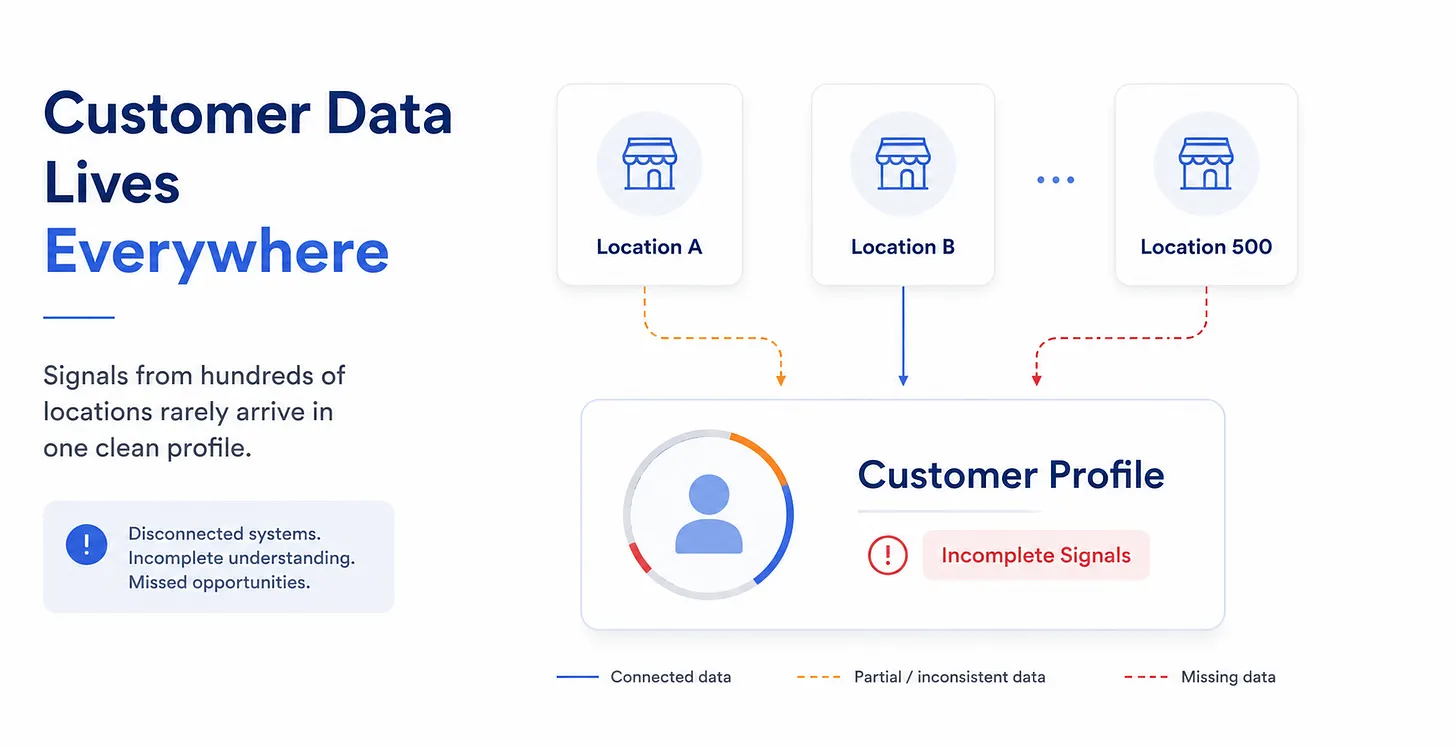
Personalization lives or dies on data, and multi-location businesses tend to have a data problem that compounds in proportion to their footprint. Customer behaviour at location one is captured in one system. Location two uses a slightly different POS setup that exports differently. The loyalty programme operates on a separate platform that was integrated two years ago but has known data quality issues that nobody has had the bandwidth to fix. The digital advertising platforms hold their own behavioural data, but connecting it to the in-store customer record requires an identity resolution step that introduces both technical complexity and meaningful match rate uncertainty.
By the time you are trying to serve a personalised ad to a customer who visited your Birmingham location last week, the signal you are working with may be incomplete, delayed, or incorrectly attributed. And that is in a relatively clean scenario. Add franchise ownership complexity, where different operators have different levels of enthusiasm for data integration, and the problem compounds further.
This is not a problem that better software alone solves. It is a problem of organisational priority and investment. Meaningful personalization requires treating customer data as a core business asset: cleaning it, governing it, connecting it with discipline, and maintaining it over time. Most organisations say they do this. Fewer actually do it at the level of rigour that genuine personalization requires.
The Creative and Operational Burden at Scale
Assume the data problem is solved. The next constraint is creative production. Genuine personalization does not mean one message delivered to a segmented audience. It means a range of messages, each calibrated to a different customer context, each requiring its own creative execution, testing, and iteration. Across 500 locations, the combinations of geography, behaviour, timing, and channel multiply quickly into a production challenge that most creative teams are not staffed to absorb.
Dynamic creative optimisation tools exist to address this. They allow components of an ad to be assembled programmatically from a library of elements, serving different combinations based on rules or machine learning. This works reasonably well when the underlying creative is strong and the audience signals are clean. It produces mediocre results when the creative library is thin, the signal is noisy, or the assembly logic has not been thought through carefully.
The local operator layer adds another dimension. A centralised creative system may be able to generate a personalised offer for a customer near a specific location, but whether that offer reflects anything meaningful about that location’s actual inventory, competitive context, or seasonal conditions depends on information that often lives with the local operator rather than the central system. Closing that loop requires a workflow that most brands have not fully designed.
When Personalization Starts Feeling Creepy
The Line That Moves Without Warning
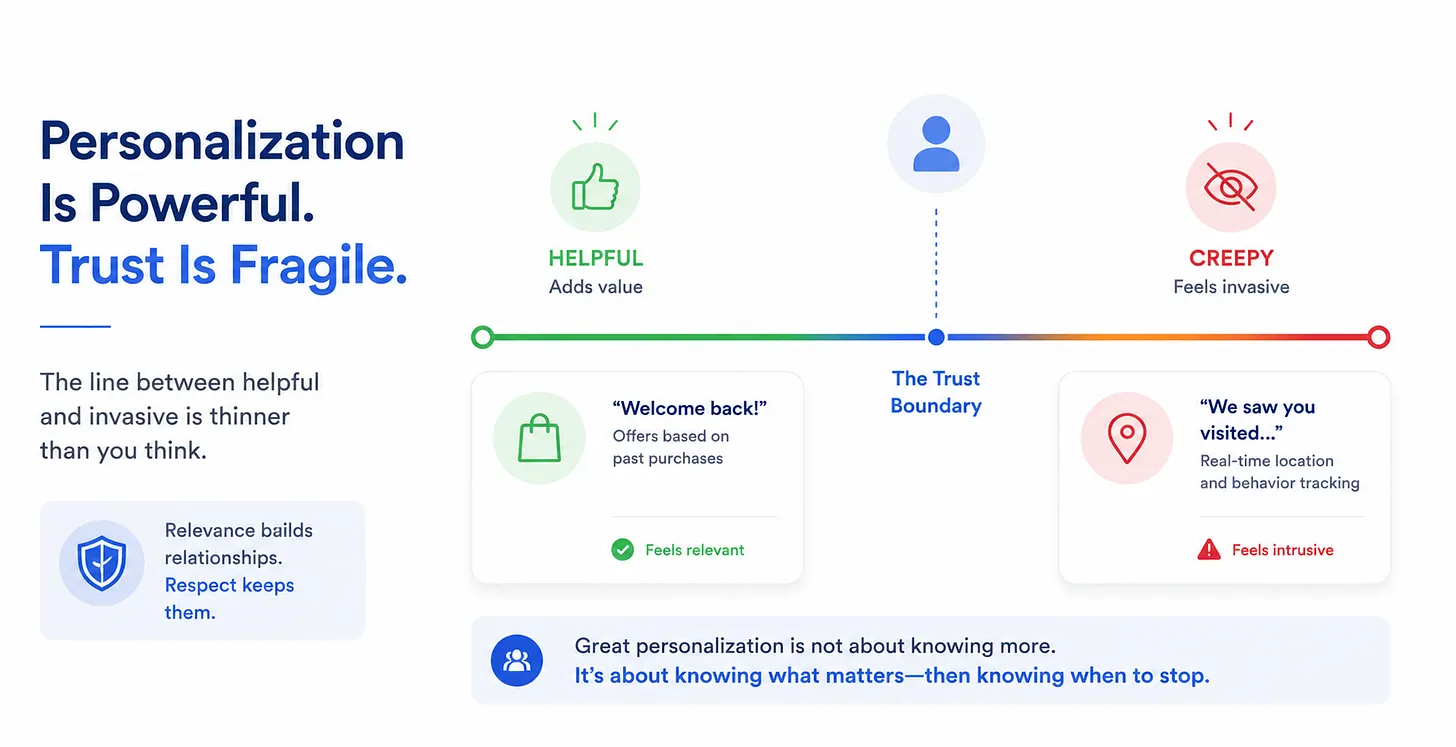
There is a version of personalization that feels useful, and a version that feels watched. The distance between them is smaller than most marketers assume, and it shifts depending on the customer, the context, and the category.
A coffee brand that serves a customer a promotion for their usual order feels convenient. A healthcare-adjacent brand that surfaces an ad for a product related to a search the customer made on their phone feels invasive. The difference is not really about the technology. It is about whether the customer perceives the brand as having information they did not knowingly share, or as connecting dots in a way that feels disproportionate to the relationship.
The challenge for large multi-location brands is that they are operating at a scale where the data signals they are working with are genuinely extensive, but the customer’s sense of their relationship with any individual location is often quite local and bounded. A customer who thinks of themselves as a regular at a single neighbourhood location may be surprised to discover that their behaviour across three cities is being synthesised into a unified profile driving advertising decisions. That synthesis is, from a marketing logic standpoint, entirely reasonable. From a consumer perception standpoint, it can feel like a violation of an implicit trust they did not know they had extended.
This does not mean personalisation at scale is inherently problematic. It means the targeting logic needs to be calibrated with an understanding of what customers in a given category and relationship type are comfortable with. Brands that use behavioural data to improve relevance without surfacing that they are doing so tend to earn more durable trust than brands that make the personalisation visible in ways that feel demonstrative rather than useful. The goal is to be helpful without being conspicuous about it.
The Local Knowledge That No Algorithm Has
One of the more persistent illusions in enterprise personalisation strategy is that sufficiently sophisticated data systems can substitute for local market knowledge. They cannot, at least not fully.
A predictive model built on historical purchase data can tell you that a certain customer segment in a certain postcode is more likely to convert on a Tuesday morning than a Saturday afternoon. What it cannot tell you is that the new residential development nearby has changed the demographic profile of lunchtime foot traffic in the last six months. It cannot tell you that the local school holiday calendar shifts family visit patterns in ways that take years to show clearly in aggregate data. It cannot tell you that a competitor opened last month and is running aggressive pricing that looks like audience behaviour change in the data but is actually competitive context.
Local operators hold this knowledge. The franchise systems that use it well have found ways to integrate it into marketing decisions, either through structured feedback mechanisms or by giving local teams enough flexibility to adapt campaign parameters within centrally defined guardrails. The ones that treat local knowledge as noise to be averaged out in the aggregate model consistently underperform against brands with similar data infrastructure but better human intelligence loops.
What Effective Personalization Actually Looks Like When Systems Mature
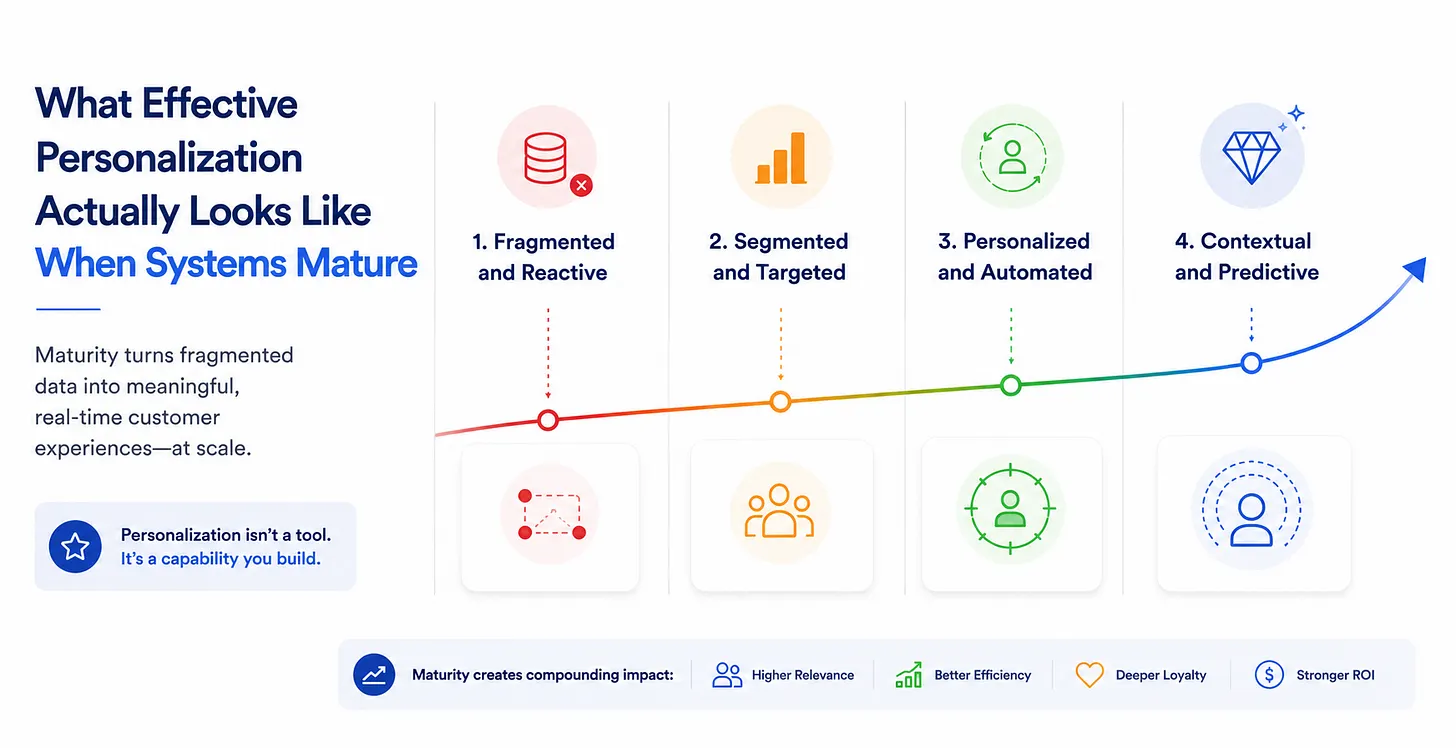
Brands that have been doing this long enough to have learned from their mistakes tend to have arrived at a more modest and more functional definition of personalisation than the one they started with. They are not trying to treat every customer as a unique individual in every interaction. They are trying to ensure that the most consequential moments in the customer relationship are handled with genuine contextual intelligence.
That means knowing the difference between a lapsed customer and a lost one, and not treating them identically. It means recognising that a customer visiting a new location for the first time is in a different state than a regular. It means understanding that seasonal and geographic context shapes relevance in ways that behavioural data alone cannot capture, and building systems to incorporate that context rather than ignoring it.
None of this requires the most sophisticated personalization infrastructure available. It requires clarity about which decisions actually benefit from personalization and which are being personalised because the capability exists rather than because the customer would notice or care. That discipline, the willingness to ask whether a given personalization investment improves the customer experience or simply adds operational complexity, is what separates mature programs from expensive experiments that produce impressive dashboards and modest results.
Effective personalisation is rarely as precise as it looks in the demo. It is contextually aware rather than individually precise. It is built on data that is clean enough to be directionally reliable rather than perfectly accurate. And it is calibrated to what the customer relationship actually is rather than what the marketing team wishes it were. That is a less glamorous version of the promise. It is also the version that tends to work.
Standard audience segmentation groups customers by shared characteristics, typically demographic or broad behavioural categories, and serves each group a variant of the same message. Hyper-personalization goes further by using individual-level behavioural signals, purchase history, location context, and real-time triggers to shape messaging at the level of the specific customer rather than the segment they belong to. In practice, the distinction is less binary than it sounds. Most brands operating at scale are working somewhere on a spectrum between the two, and the most meaningful gains often come not from pushing to the individualised extreme but from improving the contextual relevance of messaging at key moments in the customer relationship, such as recognising a lapsed customer differently from an active one, or adjusting offers based on recent visit behaviour rather than demographic averages.
Identity resolution is the process of connecting data about the same customer that exists in different systems, such as a loyalty programme, a POS system, a mobile app, and digital advertising platforms, into a single unified profile. For multi-location brands, this is complicated by the fact that customer data is often captured differently across locations, with varying fields, naming conventions, and integration standards depending on operator setup and technology choices. When a customer visits different locations, their behaviour may exist as separate, unconnected records rather than a coherent history. Connecting these records requires matching on shared identifiers such as email, phone number, or device ID, each of which introduces its own match rate uncertainty and data governance considerations. The result is that the unified customer view that personalization strategy depends on is often less complete than it appears in planning documents.
The most useful test is whether the customer would notice or benefit from the personalization in a way that meaningfully affects their behaviour or perception of the brand. Personalization at high-stakes moments, such as re-engagement after a long absence, a first visit to a new location, or a response to a specific recent purchase, tends to produce measurable lift because the contextual relevance is genuine. Personalization applied uniformly across all communications, because the technical capability exists, often adds operational complexity without producing proportionate customer value. The discipline of deciding where personalization earns its cost is what separates mature programmes from expensive experiments. A practical starting point is to identify the three or four customer states that most affect long-term value retention and focus personalization investment there before expanding to lower-stakes interactions.
The threshold varies by category, channel, and the nature of the customer relationship, but the underlying principle is consistent: personalization feels useful when it reflects information the customer would expect the brand to have given their relationship, and invasive when it surfaces information that feels disproportionate to that relationship or appears to have been gathered without explicit awareness. A brand with a loyalty programme that uses purchase history to personalise offers is operating within a frame the customer opted into. A brand that synthesises browsing behaviour, location data, and purchase history across multiple channels to build a profile the customer has never seen or consented to in any meaningful sense is operating in territory where consumer comfort is much lower and regulatory scrutiny is increasing. For multi-location brands specifically, the risk is that the scale of data aggregation across locations exceeds what the customer's mental model of their relationship with any individual location would lead them to expect.
Yes, but it requires deliberate design rather than happening automatically. The most common approach is a structured feedback mechanism where local operators can flag market-specific conditions, such as a new competitor, a local event, or a demographic shift, that should be factored into campaign parameters for their location. Some franchise systems build this into their campaign management workflow explicitly, giving local operators the ability to adjust offer values, timing, or creative emphasis within centrally defined guardrails. Others operate regional advisory structures where clusters of operators surface local intelligence to a regional marketing team that translates it into system-level adjustments. What does not work is assuming that aggregate behavioural data from the central system will eventually capture what local operators know from direct experience. Some local knowledge, particularly around competitive context and community dynamics, is qualitative and forward-looking in ways that historical data cannot anticipate.