Research Labs
What's the Right Way to Allocate National Marketing Fund (NMF) Dollars?
Balancing long-term brand equity with short-term performance pressure.

Budget conversations inside companies almost never begin with strategy. They begin with precedent. Last year’s allocation becomes this year’s baseline, and the fight is over what moves at the margins. National Marketing Funds are particularly susceptible to this pattern because they sit at an uncomfortable intersection of collective resources and competing agendas. Everybody contributed. Everybody has an opinion about how the money should be spent. And the people with the loudest opinions are rarely the ones closest to the customer.
The result is that NMF allocation, in most organisations, is less a strategic exercise than a political one. Which is a problem, because the stakes are real. NMF dollars are meant to do something that no individual franchisee, regional manager, or local operator can do alone: build and sustain a brand at scale. When that money gets diffused across too many priorities, misread as a performance budget, or captured by whoever argues most convincingly in a quarterly meeting, the brand pays for it slowly and unevenly in ways that are hard to trace back to any single decision.
What National Marketing Funds Actually Are, and Why They're Complicated
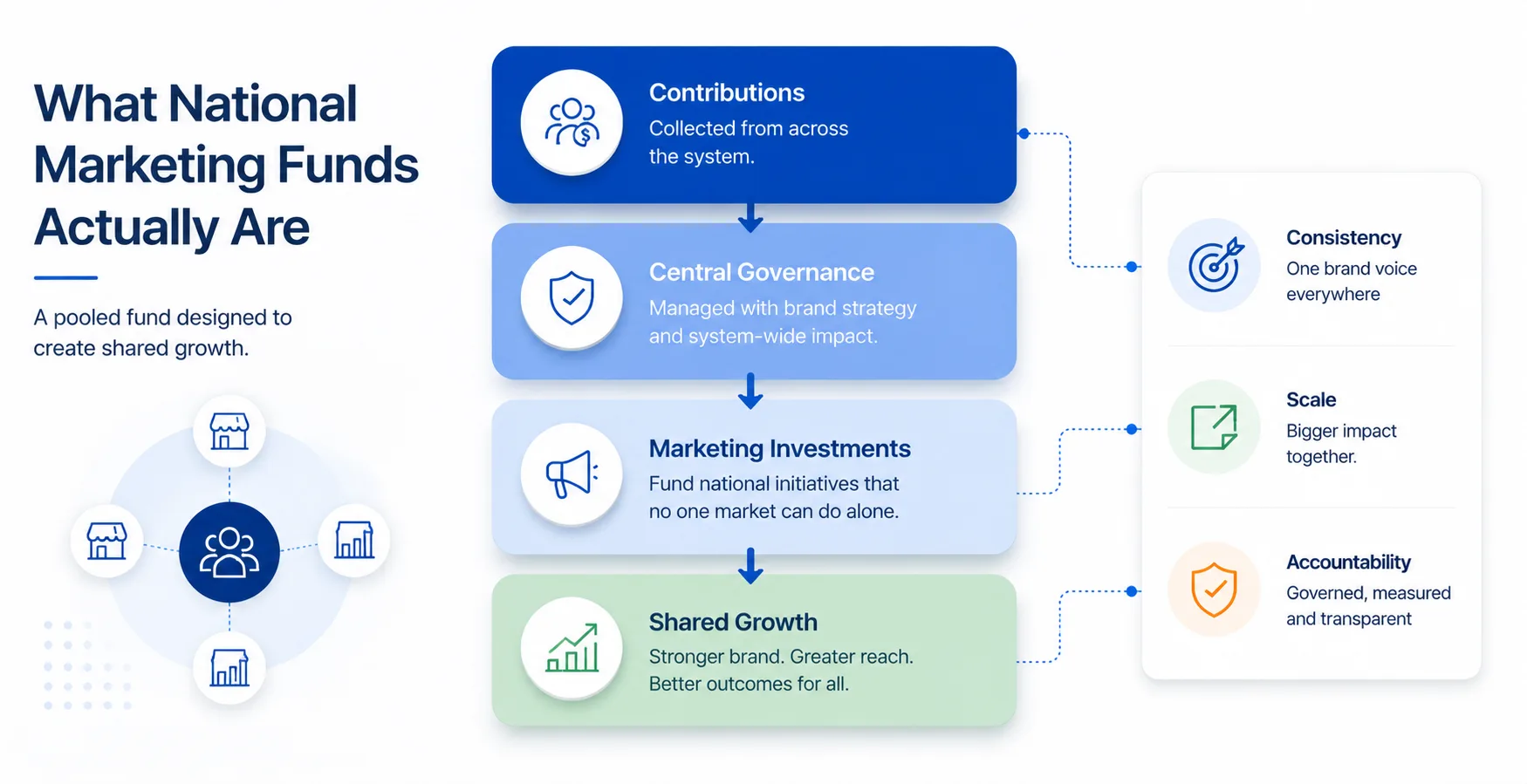
At the most basic level, an NMF is a pooled marketing budget, typically collected as a percentage of revenue from franchisees, network partners, or business units, and managed centrally to fund marketing activities that benefit the entire system. The structure exists because brand-building requires a level of investment and consistency that fragmented, locally-managed spending almost never produces.
That logic is sound. The problems start in implementation.
The first complication is that the people contributing to the fund and the people spending it are often operating with entirely different time horizons. A franchisee thinking about this quarter’s foot traffic has a different conception of what “useful marketing” means than a central brand team thinking about unaided awareness over a three-year arc. Both are legitimate perspectives. But when the governance structure doesn’t account for this tension deliberately, the fund ends up serving neither objective particularly well.
The second complication is accountability. Pooled funds have a diffuse ownership problem. Everyone contributed, which means any given contributor feels some entitlement to influence how it’s spent, but no single contributor feels the concentrated responsibility for whether it works. This diffusion of accountability tends to produce risk-averse, consensus-driven spending. Safe media choices. Proven channels. Nothing that could be easily criticised at the next steering committee meeting.
The Brand-Building vs. Performance Tension Nobody Fully Resolves
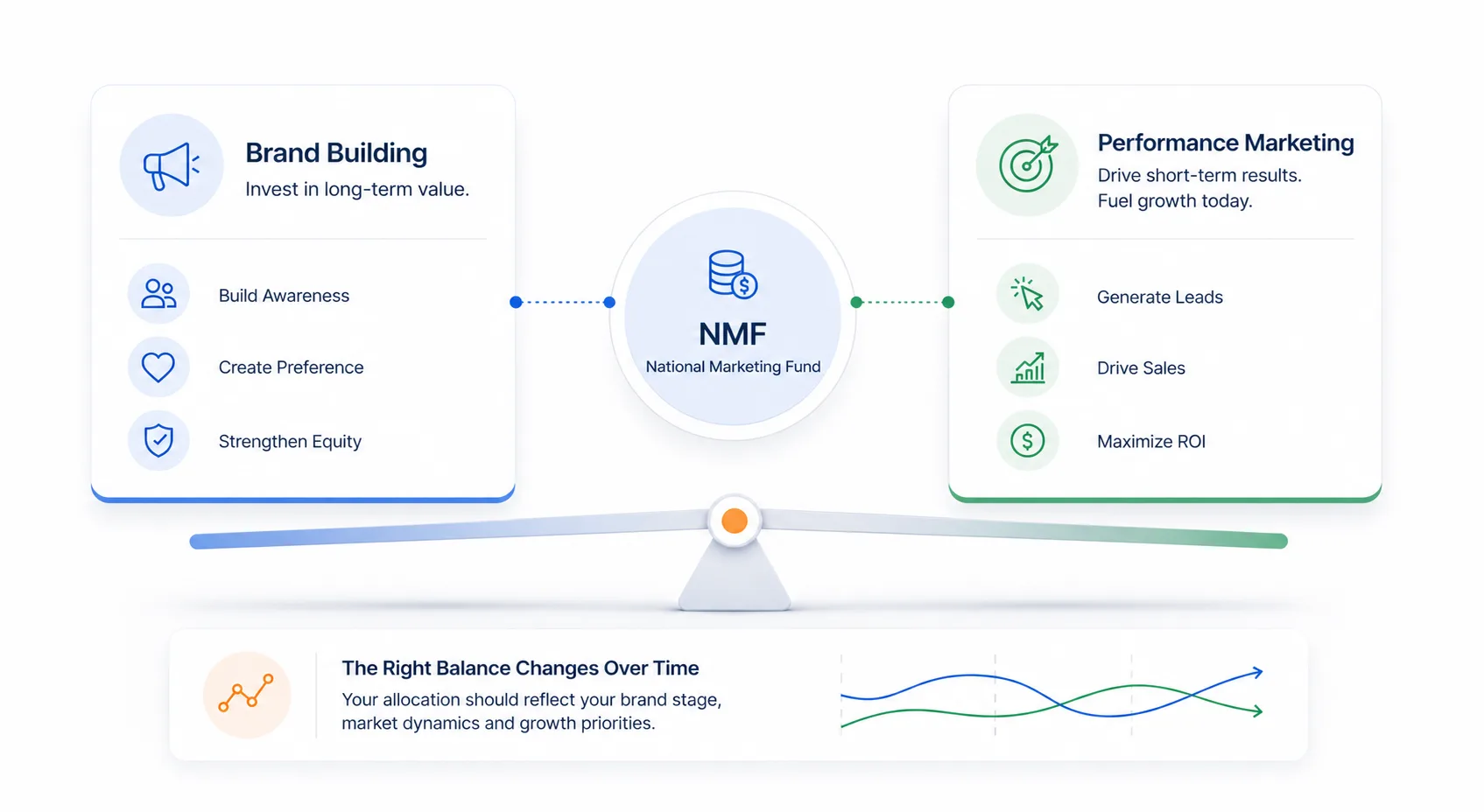
This is probably the most persistent structural conflict in NMF allocation, and it plays out in some form in almost every organisation that manages one.
Performance marketing is measurable, attributable, and fast. You spend money on paid search or targeted digital, and within a reasonable window you can point to clicks, leads, or transactions. The numbers are clean. The narrative is easy. For anyone who has to justify a budget to a CFO or a room full of franchisees asking where their money went, performance channels are a safe answer.
Brand-building is slower, harder to attribute, and much easier to cut when times are tight. Awareness campaigns, sponsorships, content investment, the kind of spending that creates the cultural presence that makes performance marketing work better over time. These don’t produce a clean number at the end of a quarter. They produce compounding effects that are only visible in hindsight, and only if you were measuring the right things in the first place.
The tension is that both are necessary, and the balance is not static. A brand in an early growth phase needs different allocation logic than a mature brand defending market share. A brand with low unaided awareness in a new geography needs different investment than one running saturated media in a home market. But because NMF allocation processes tend to move slowly and conservatively, the balance rarely shifts as nimbly as the business actually requires.
The practical consequence is that most NMF portfolios are overweight in performance and underweight in brand. Not because anyone consciously decided that, but because performance spending is easier to defend in a room.
The Politics of Allocation and Why Data Doesn't Always Win
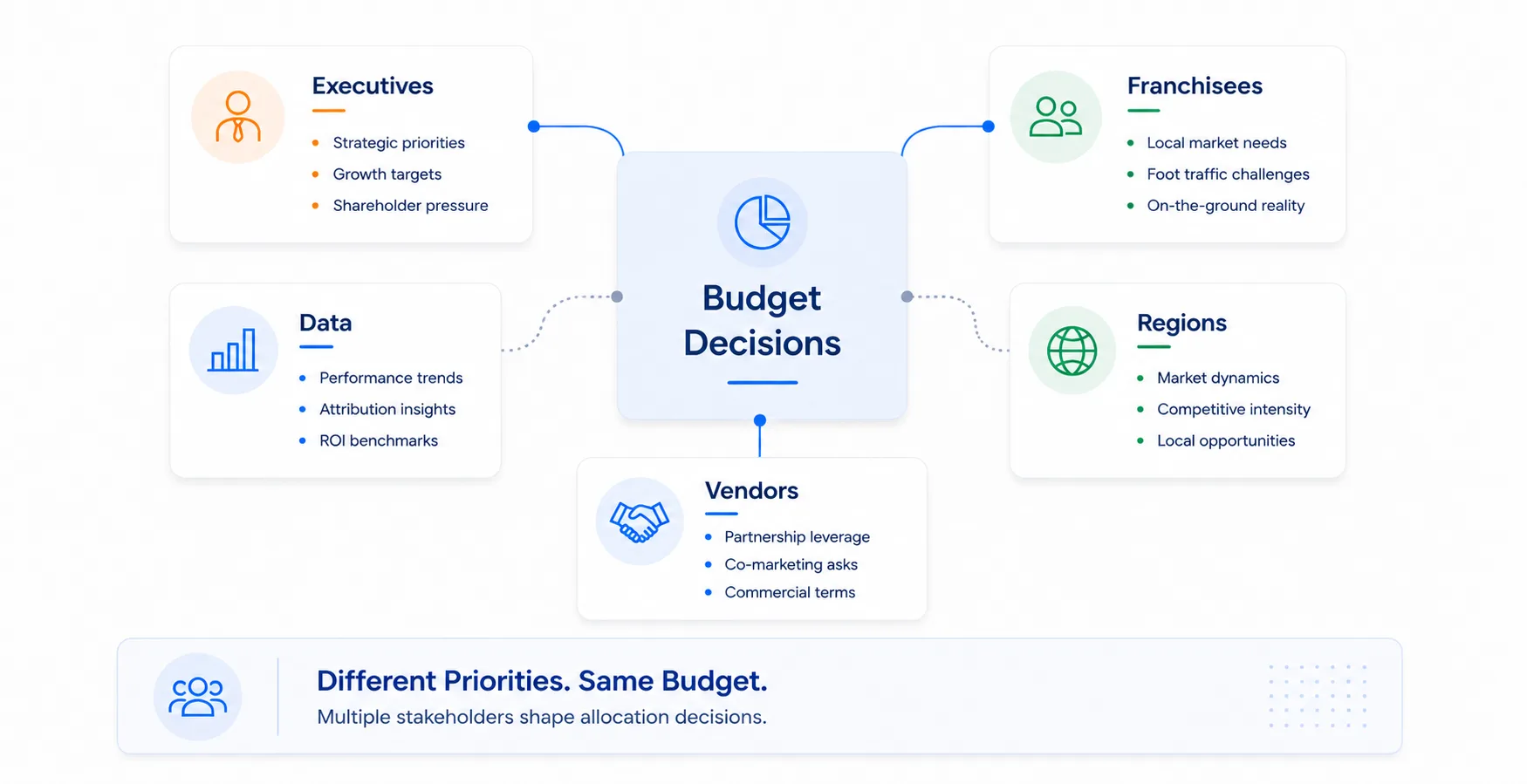
In theory, allocation decisions should follow the evidence. Channels that deliver results get more money. Channels that underperform get cut or restructured. Attribution models inform priorities. Testing informs scale.
In practice, the people who control budget narratives are not always the people closest to the data. A regional director who has run the same TV buy for six years and has a relationship with the station rep is not a neutral evaluator of whether that spend is still earning its place. A central brand team with strong opinions about premium positioning may resist performance data suggesting that a mid-market creative approach is outperforming their preferred aesthetic. Executive instincts, vendor relationships, and internal political capital all shape allocation outcomes in ways that no attribution dashboard fully counteracts.
This is not unique to marketing. It is how resource allocation works inside organisations generally. But it matters more with NMF dollars because the contributors to the fund are watching how the money gets spent and forming opinions about whether the system is working for them. When franchisees in secondary markets watch national spend concentrate on primary cities for the fifth consecutive year, they stop trusting the process. That erosion of trust has downstream effects on participation, compliance, and the overall health of the network.
Local vs. National: The Allocation Fault Line
When Centralisation Stops Serving Local Markets
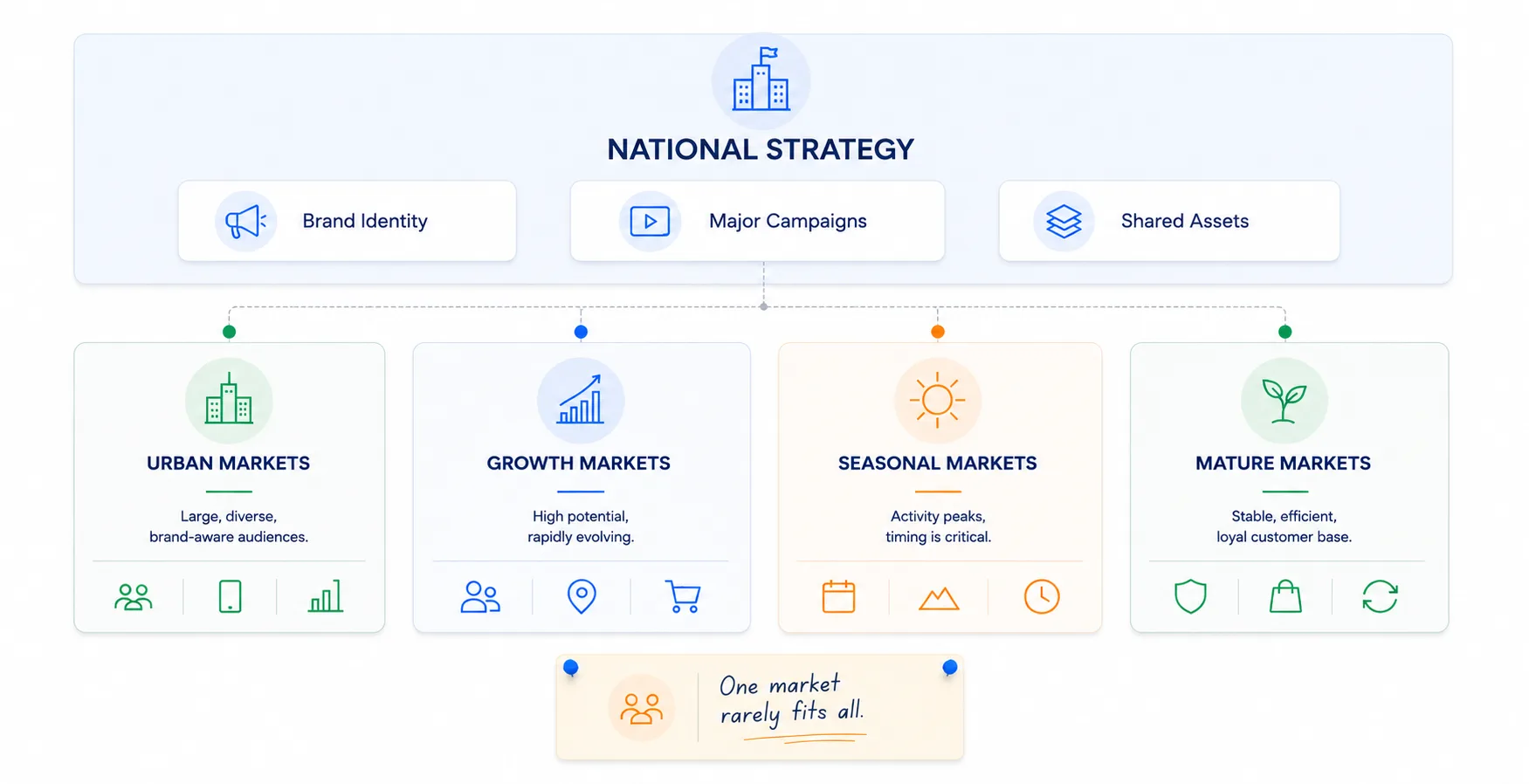
There is a version of NMF governance that treats local market variation as noise to be managed rather than signal to be acted on. One national campaign, one media mix, one set of creative assets, deployed uniformly across markets with different competitive dynamics, different customer profiles, and different stages of brand maturity.
This approach is operationally convenient and strategically blunt. Markets where the brand is already well-established don’t need the same awareness investment as markets where it’s still building recognition. Urban and suburban audiences often respond to different messages. Seasonal variation in purchase behaviour is real and geographically uneven.
The organisations that handle this best tend to work with a tiered model: a national brand fund that funds genuinely national priorities such as consistent brand identity, major campaign development, and channels that require national scale to be effective, combined with a regional or local co-op layer that gives markets some flexibility to address their specific conditions. This is not a new idea, but it is executed well less often than it should be, usually because the governance required to run it cleanly is harder than it looks.
How ROI Gets Measured, and Where That Measurement Falls Short
Attribution is the dominant language of modern marketing ROI, and for good reason. But it has specific blind spots that matter enormously for NMF evaluation.
Last-touch attribution, which remains surprisingly common even in organisations with sophisticated analytics, systematically undervalues brand investment by crediting conversion to the final touchpoint rather than the broader journey that made conversion possible. A customer who saw a national TV spot six weeks ago, encountered a social ad two weeks ago, and then clicked a search ad yesterday does not represent a story about paid search performance. They represent a story about how multiple channels work together over time.
Multi-touch and data-driven attribution models are better but not perfect. They require clean data, disciplined tagging, and consistent measurement across channels that often have very different tracking capabilities. They also require organisational patience, because the insights they produce are only meaningful if you maintain the framework long enough to see patterns across seasons and cycles.
The deeper problem is that some of what NMF buys is genuinely not measurable in any direct way. Brand trust is not a metric that shows up in a monthly performance report. Category presence in a consumer’s consideration set doesn’t appear on a dashboard. These things are real, and they affect business outcomes, but they require a different kind of evidence: brand tracking studies, qualitative research, long-run econometric analysis. The organisations that invest in this kind of measurement infrastructure tend to make better allocation decisions over time. The ones that don’t tend to drift toward whatever is most measurable, which is not always the same as whatever is most valuable.
What Good Allocation Actually Looks Like Over Time
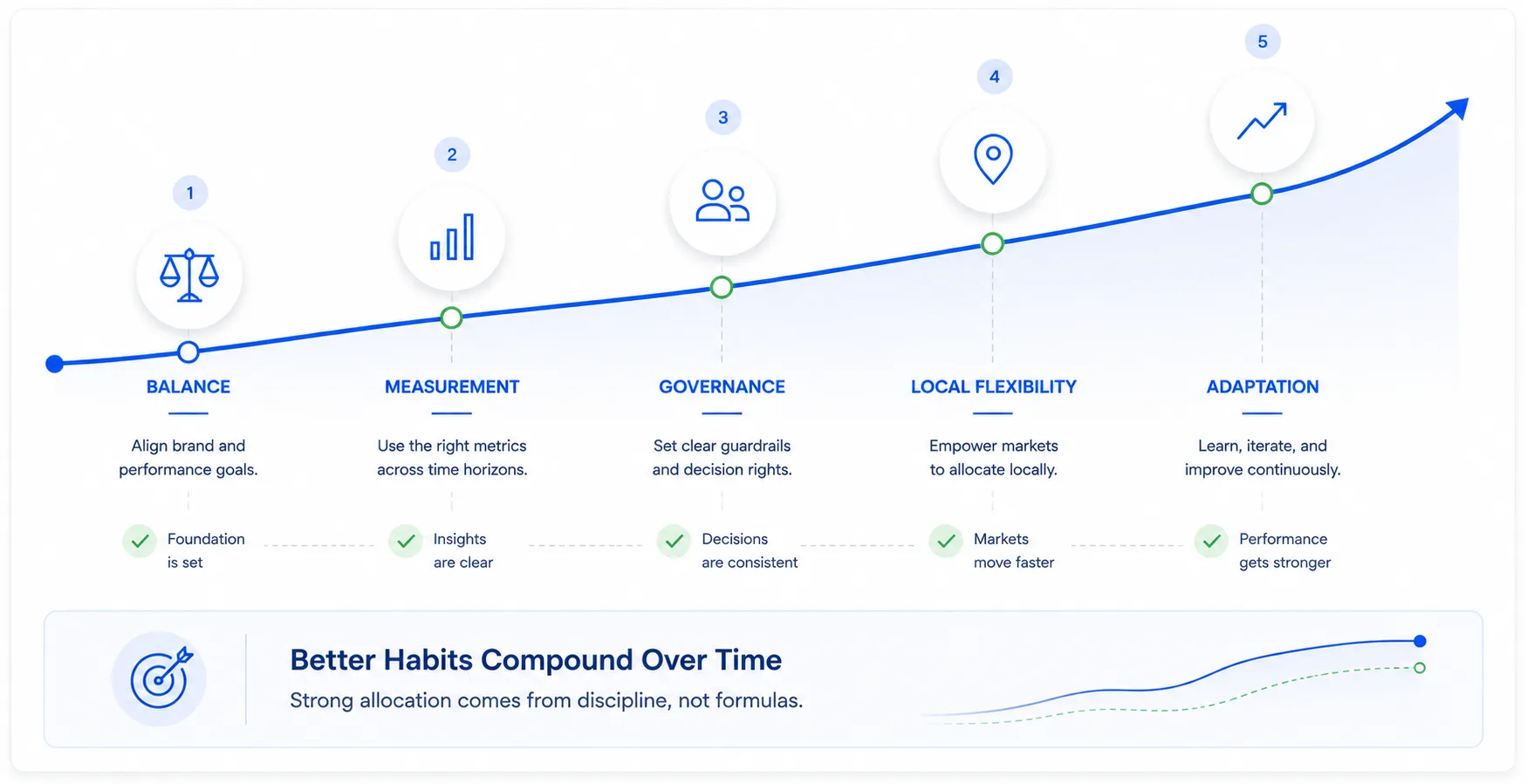
There is no formula for the right NMF allocation. Anyone who tells you otherwise is selling a framework. What there is, in the organisations that tend to get this right, is a set of habits and disciplines that accumulate over time into something that resembles a coherent approach.
They make the brand-building versus performance balance an explicit, recurring conversation rather than a residual output of whoever argued most convincingly last quarter. They invest in measurement infrastructure that can capture long-run brand effects, not just short-run conversion. They build governance structures that give contributors enough visibility into spending decisions to maintain trust in the system, without giving every stakeholder veto power over every choice. They treat local market variation as information rather than inconvenience. And they revisit the allocation logic when the business context changes, rather than treating last year’s split as a permanent default.
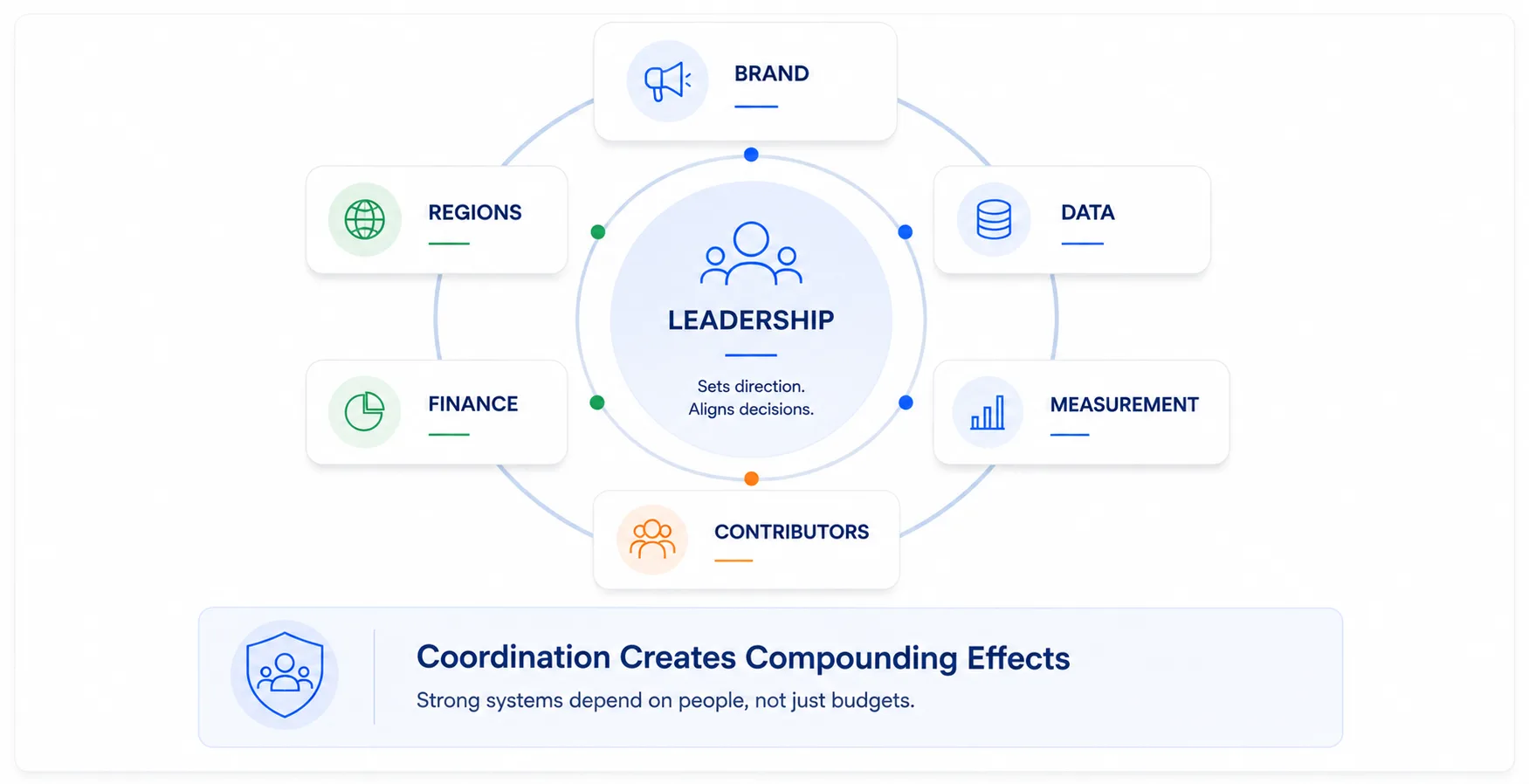
None of this is particularly complicated in principle. It is complicated in practice because it requires managing people, politics, and incentives alongside the actual marketing work. The organisations that navigate it well tend to have someone, or some function, with enough credibility and enough authority to hold the strategic logic together across multiple stakeholder groups and multiple budget cycles.
That role is underappreciated in most NMF governance conversations. People focus on the allocation percentages and the channel mix. The harder question is who is actually responsible for making sure the allocation serves the brand over a long enough time horizon to matter. Without a clear answer to that, the money will keep flowing toward whatever is easiest to explain in the next quarterly review.
There is no universally correct split, and any specific ratio should be treated with scepticism. The right balance depends on factors like the brand's current awareness levels, its stage of growth, how saturated existing markets are, and whether the network is expanding into new geographies. A newer brand with low unaided awareness needs a heavier brand investment than a mature one defending its position. What matters more than any fixed ratio is treating the question as a deliberate, recurring decision rather than a default carried over from last year's budget.
The most effective approach tends to separate the two layers explicitly. Central funds cover what genuinely requires national scale: brand identity, major campaign development, channels that don't work at local spend levels. Regional or co-op funds give local operators flexibility to address market-specific conditions. The governance structure should give franchisees enough visibility into how central spend decisions are made to maintain trust, without turning every allocation decision into a vote. Lack of transparency is one of the fastest ways to erode franchisee confidence in the system.
Last-touch attribution assigns full credit for a conversion to the final marketing touchpoint before a customer acts. This systematically overstates the contribution of direct-response channels like paid search, which are often the last step in a journey that began with brand exposure weeks or months earlier. A customer who became aware of a brand through a national campaign, remained in the consideration set due to consistent presence, and then converted through a search ad is not a story about paid search. Multi-touch and data-driven models partially address this, but they require clean data infrastructure and long measurement windows to produce reliable signals.
Brand tracking studies, which measure unaided and aided awareness, consideration, and preference over time, are the most direct tool. Econometric modelling (also called marketing mix modelling) can decompose sales outcomes across paid, owned, and earned channels including brand-level spend, though it requires sufficient data history and a rigorous methodology to be reliable. Qualitative research can surface whether the brand's positioning is landing in the way the creative intends. No single approach is sufficient on its own. The organisations that make the best long-run allocation decisions typically invest in a combination of these, and they maintain the frameworks consistently enough to track results across full business cycles.
At minimum, annually, and more frequently when the business context changes materially. A significant shift in competitive dynamics, entry into a new geography, a change in consumer behaviour, or a major economic disruption can all make the prior year's allocation logic obsolete. The mistake most organisations make is treating the existing split as a baseline that only moves at the margins. A better approach is to treat each budget cycle as an opportunity to revalidate the strategic rationale for the current mix, and to adjust proactively rather than reactively.