Research Labs
When Should HQ Override a Franchisee's Local Marketing Decision?
Franchise marketing disputes are rarely just about the ad. Learn when franchisor intervention is justified, when it isn't, and how healthy franchise systems build the trust that makes the difference

When Should HQ Override a Franchisee's Local Marketing Decision?
Franchise marketing disputes are rarely about the ad. On the surface they look like disagreements about creative direction, discount depth, or whether a local radio buy was worth the spend. But underneath, they are almost always about something else: who understands this customer better, who bears the financial consequences, and whether the relationship between franchisor and franchisee is built on genuine trust or a governance structure that substitutes process for it.
These conflicts rarely arrive cleanly. They come loaded with months of prior friction, unresolved grievances, and a power dynamic that both sides are careful not to name directly. A franchisee who feels heard and respected responds very differently to a content restriction than one who has been fighting the same battle with a regional manager for two years. The marketing question and the relationship question are not separate. They are the same question wearing different clothes.
The companies that navigate this well are not the ones with the most detailed approval frameworks. They are the ones that have done the harder work of building a system where intervention feels like partnership rather than punishment.
Why the Tension Is Structural, Not Personal
The franchisor and franchisee are not in the same business, even though they share a brand. The franchisor is building a system over a long time horizon, protecting brand equity across hundreds or thousands of locations, managing consistency as a competitive asset. The franchisee is running a local business, competing for customers who have immediate alternatives, responding to conditions that a central team may not fully see from a national vantage point.
These are legitimate, incompatible instincts operating in the same space. A franchisee in a market where a local competitor is running aggressive price promotions has a genuine operational reason to want to respond in kind. HQ, watching brand positioning across a national footprint, has a genuine strategic reason to resist normalising discounting. Both are right about something. Neither is completely right.
The incentive structures are misaligned in ways that nobody designed deliberately but everyone ends up living with. Franchisees have invested their own capital. Their risk is concentrated in a single geography. When a franchisee pushes back on an HQ marketing directive, it is worth asking what information asymmetry might be driving that reaction, rather than assuming the franchisee simply doesn’t understand the strategy.
When HQ Override Is Not Optional
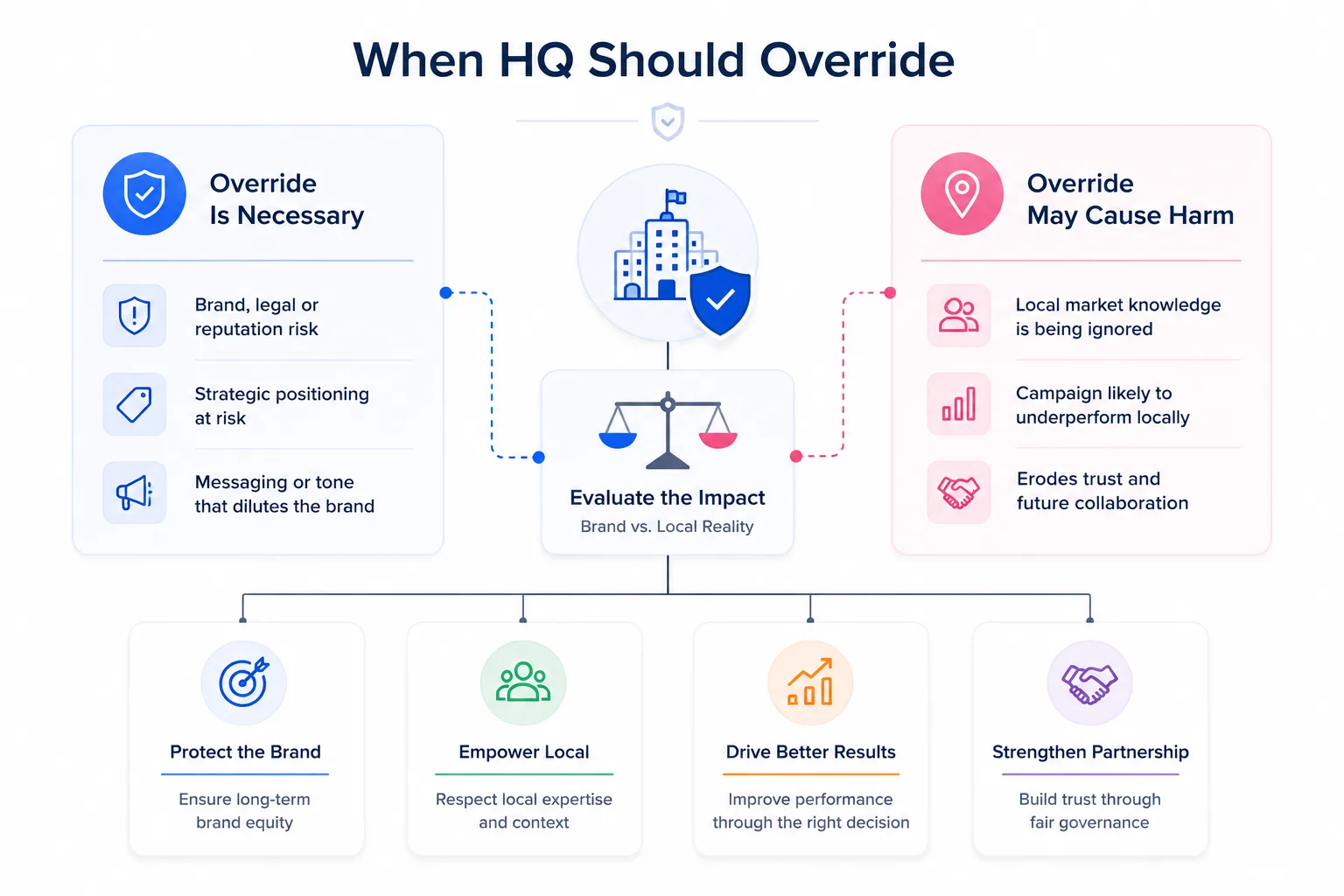
There are situations where HQ intervention is not a preference but a responsibility. The clearest ones involve brand safety and legal exposure: a franchisee running a promotion that makes claims the product cannot support, advertising in a way that creates liability for the network, or using creative assets that have not been cleared for use. These are not judgment calls. They are the baseline conditions for operating a franchise system with any coherence.
Less clear, but equally important, is the case of messaging that is technically permissible but strategically damaging. A franchisee in a premium-positioned brand who starts running heavy discount promotions to drive volume is not just making a local marketing decision. They are making a positioning decision on behalf of the entire brand in that market, and potentially in adjacent markets where customers cross over. Price perception spreads. If one location in a metropolitan area is running regular two-for-one offers, the customer sitting in another location the next week has already updated their mental model of what this brand is worth.
The same logic applies to tone. Brand voice is not just a style guide preference. It is the accumulated result of years of consistent communication that creates a particular emotional relationship with a particular audience. A franchisee who decides that a more aggressive, high-pressure tone will drive short-term conversions may be right about the short-term outcome. They are almost certainly wrong about the long-term cost, which accrues not just to them but to every operator in the system.
In these cases, override is not interference. It is stewardship of a shared asset.
When HQ Interference Actually Costs the Brand
The harder conversation is the one about when HQ gets it wrong. And it does, with regularity, because central teams have structural blind spots that local operators spend years navigating.
A national creative campaign developed for a broad demographic average can perform poorly in markets where the customer base is culturally distinct. A promotional calendar built around climate patterns in one region makes no operational sense in another. A media mix optimised for urban markets with high digital penetration underperforms in geographies where local radio and community newspapers still drive meaningful reach.
When franchisees raise these concerns and are overruled without genuine consideration, two things happen. The marketing underperforms, and the franchisee bears the financial consequence of a decision they didn’t make. Then trust erodes. Once trust erodes, the governance machinery starts to matter more than it should. The franchisee looks for workarounds. The central team responds with tighter controls. This cycle is expensive and almost entirely avoidable if the original concern had been treated as useful information rather than resistance to be managed.
The most damaging version of this is when HQ mistakes uniformity for consistency. Consistency means the brand delivers on its core promise reliably across every market. Uniformity means every execution looks identical regardless of context. The brands that require uniformity as a proxy for consistency tend to be the ones that haven’t done the harder work of defining what the core promise actually is.
Local Context and What Central Teams Miss
The Customer HQ Has Never Met
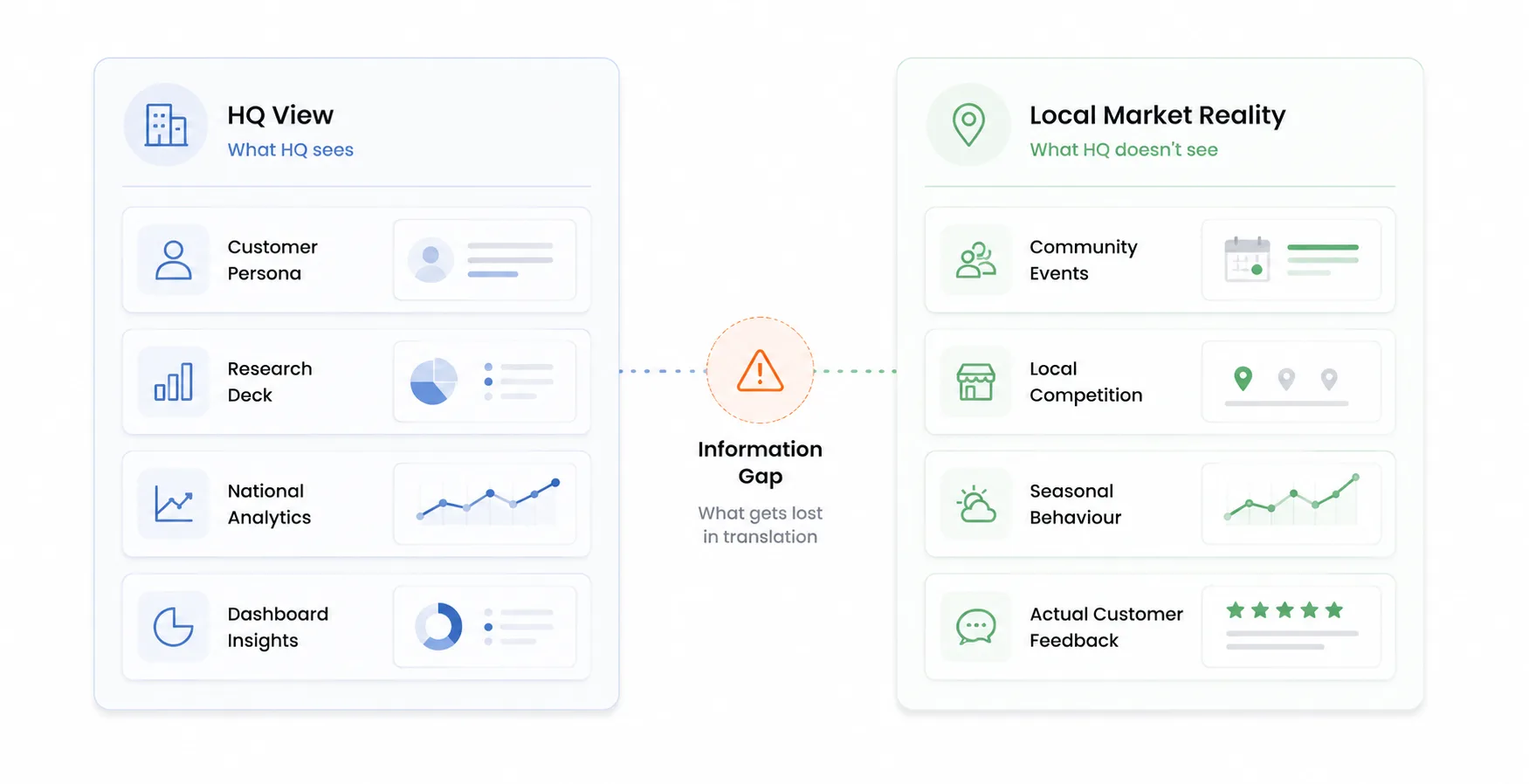
There is a version of a brand’s target customer that lives in a research deck somewhere at headquarters. They have been given a name, a lifestyle profile, a set of values, and a media consumption pattern. This persona is a useful fiction. It is a composite of data that approximates something real but never fully captures it.
The franchisee has met the actual customer. They know that the lunchtime crowd in their specific location is different from the dinner crowd, and both are different from the customer profile in the national research. They know that the promotion that drove traffic last summer worked partly because of a local event that brought a different demographic into the area that week. They know things about their market that will never appear in a centralised analytics dashboard because nobody thought to measure them.
This knowledge has genuine value. The franchise systems that extract it well, through structured feedback mechanisms, regional advisory councils, or simply by treating local operators as a source of market intelligence rather than an implementation layer, make better decisions because of it. The ones that don’t are flying partially blind and often don’t know it.
The Governance Problem and How It Gets Political
Most franchise systems have some form of marketing approval process: brand standards documentation, creative review requirements, pre-approved vendor lists. These structures exist for good reasons, and they function reasonably well as long as the volume of decisions they are asked to process remains manageable and the people running them maintain the trust of the operators going through them.
What tends to happen over time is that approval processes expand to cover more decisions without a corresponding expansion in the resources or responsiveness required to run them well. A franchisee waiting three weeks for approval on a locally-funded social media campaign tied to a community event is not experiencing brand governance. They are experiencing bureaucratic friction that serves nobody.
The politics layer in when approval processes become instruments of control rather than quality: when regional managers use delays to signal displeasure, when certain operators find their submissions move faster because of relationships rather than merit, when the process rewards compliance over creative quality. At that point, the governance system is no longer protecting the brand. It is damaging the relationship that makes the brand function.
The distinction between strategic control and micromanagement is not about the number of things HQ oversees. It is about whether those things are actually worth overseeing. A brand that requires approval for every local social post while leaving pricing decisions entirely to individual operators has its priorities inverted. The question should always be: is this decision consequential enough to the brand’s long-term health to justify the friction its control creates?
What Alignment Actually Looks Like in a Healthy Franchise System
The franchise systems that navigate this tension well tend to share a few characteristics that are easier to describe than to build.
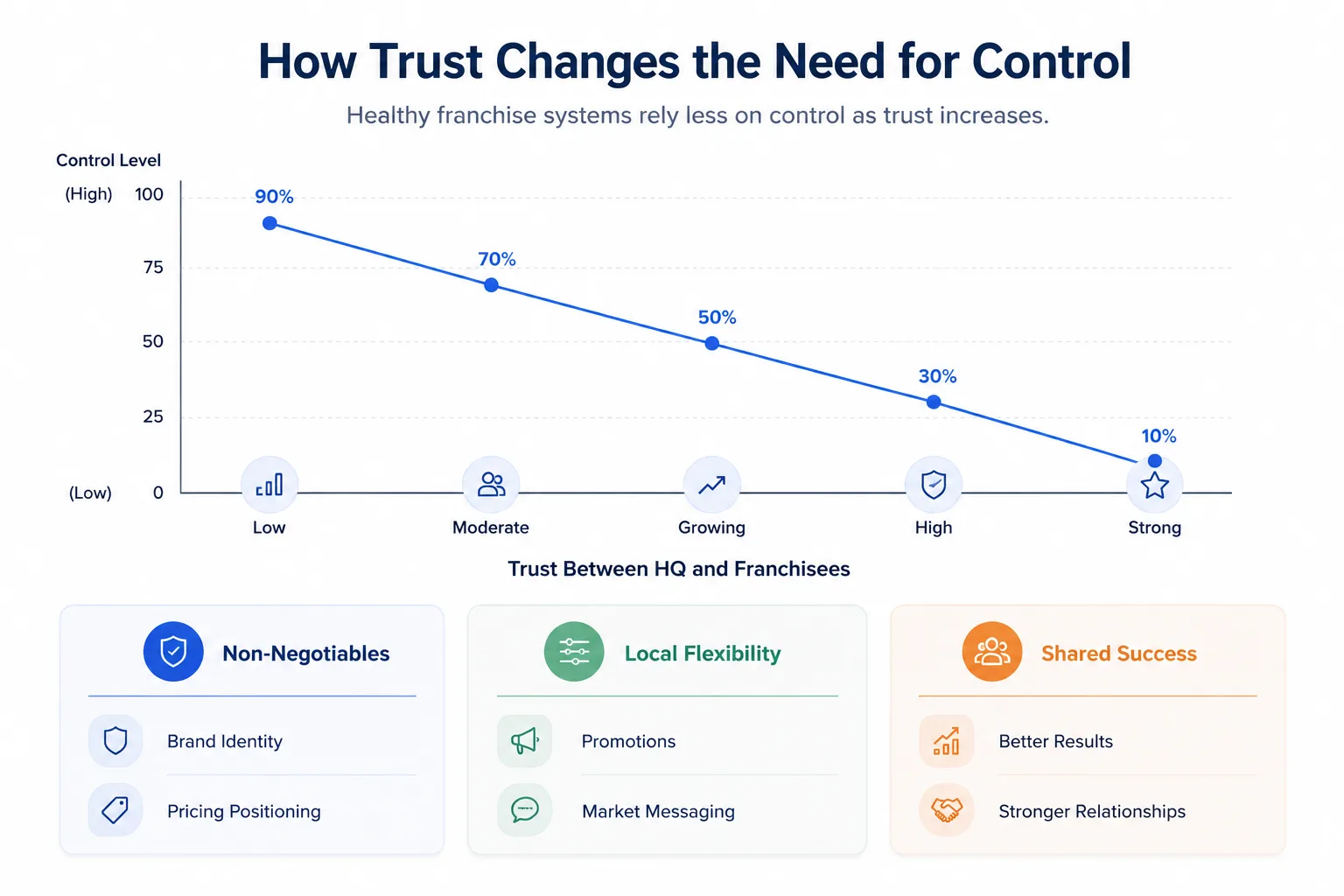
They have done the work of distinguishing non-negotiables from preferences. Non-negotiables are the things that genuinely define the brand: core visual identity, fundamental quality standards, messaging that touches pricing or positioning at a network level. These are held tightly and defended consistently. Everything else is held loosely, with clear guidance and genuine openness to local variation. Franchisees who know which is which can operate with confidence rather than spending energy trying to read where the real lines are.
They treat franchisee pushback as data. When multiple operators in different markets raise the same objection to a centralised decision, that pattern is worth investigating before doubling down. The disagreement might reflect a genuine insight about local conditions, or it might reflect a communication failure about why the decision was made. Either way, the signal is worth following.
They invest in the relationship infrastructure that makes governance feel like collaboration: regular forums where operators and brand teams work through real marketing questions together, pilots in willing markets before system-wide rollouts, and honest post-mortems when central campaigns underperform. These are the basic conditions for a relationship where override, when it does happen, reads as a considered decision rather than an assertion of authority.
The best franchise systems are not the ones with the tightest control. They are the ones that have earned enough trust that when they do step in, operators understand why. That trust is built slowly, through hundreds of small decisions about when to hold the line and when to listen. There is no shortcut to it, and no substitute for it.
Override is clearly justified when a franchisee's marketing creates legal exposure for the network, such as unsubstantiated product claims, unlicensed use of creative assets, or promotions that violate regulatory requirements. Beyond legal compliance, override is also warranted when a local decision has consequences that extend beyond the individual location. Aggressive discounting in one outlet affects price perception across the entire brand in that geography. Tone that contradicts the brand's established voice erodes the accumulated trust that brand communication has built over time. The test is whether the decision in question is truly local in its effects, or whether it imposes costs on other operators and on the brand as a whole.
The most reliable signal is pattern: when multiple operators in unconnected markets raise the same objection, the objection is almost certainly worth taking seriously. A single franchisee resisting a directive may reflect personal preference or a difficult relationship. Many franchisees independently flagging the same issue is market intelligence. Beyond pattern, the substance of the objection matters. A franchisee who can point to specific local conditions, competitive dynamics, or customer behaviour that makes a central directive a poor fit is providing actionable information. A franchisee who simply prefers to do things differently without a market-based rationale is a different conversation.
Brand consistency means that the brand delivers on its core promise reliably across every market and every touchpoint. Customers experience the same fundamental values, quality standards, and emotional register regardless of location. Brand uniformity means that every execution looks identical, uses the same creative, follows the same calendar, and applies the same media mix regardless of local context. Uniformity is operationally simpler but strategically weaker, because it treats local variation as a threat rather than a fact. A brand that has genuinely defined what its core promise is can allow significant local variation in execution while remaining entirely consistent. The brands that enforce uniformity as a substitute for that definition tend to underperform in markets where the standardised approach is a poor contextual fit.
The most effective structures share a few features. They define clearly which decisions require central approval and which can be made locally, so franchisees aren't navigating ambiguity on every choice. They set turnaround commitments for the review process and hold the central team accountable to them. They create regular forums, such as regional advisory councils or operator roundtables, where franchisees can raise market-specific concerns before those concerns become formal disputes. And they build in a meaningful pilot mechanism, so new central initiatives can be tested in willing markets before system-wide rollout. None of this eliminates tension, but it gives both sides a legitimate channel for it.
The immediate priority is containment: understanding the scope of the damage, correcting any false or misleading claims if possible, and ensuring the activity stops. Beyond that, the response should be proportionate to the severity and the context. A franchisee who ran unapproved creative because they couldn't get a timely response from the approval process is a different situation from one who deliberately circumvented brand standards after being denied. The governance failure in the first case is partly systemic. The response in the second case needs to address the relationship and the precedent it sets for the network. In both cases, the post-mortem should examine what conditions made the situation possible, not just who is at fault, because the goal is to prevent recurrence, not just to assign blame.